|
Candidates for 2026 Wyoming Primary Election (Sublette County focus) (posted 7/21/2026)
Primary Election is August 18, General Election is November 3
Pinedale Online!
United States Senator (6 year term, vote for 1)
Billy Benavidez (D)
James Byrd (D)
Jill M Edwards (R)
Harriet Hageman (R)
John Holtz (R)
Sam Mead (R)
Jimmy Skovard (R)
US Representative (2 year term, vote for 1)
Jillian Balow (R)
Bo Biteman (R)
Frank Chapman (R)
Kevin Christensen (R)
Elena Del Real (D)
Richard Dodson (R)
Steve Friess (R)
Chuck Gray (R)
Lisa Kinney (D)
Reid Rasner (R)
Governor (4 year term)
Eric Barlow (R)
Brent Bien (R)
Curt Blake (R)
Kenneth R Casner (D)
Megan Degenfelder (R)
Secretary of State (4 year term)
Bryan McCarty (D)
Qwenton Eagle Oviatt (R)
Robert Short (R)
Rachel Williams (R)
CJ Young (R)
State Auditor (4 year term)
Kristi Racines (R)
State Treasurer (4 year term)
Curt Meier (R)
Scott Smith (R)
Superintendent of Public Instruction (4 year term)
Chad Auer (R)
Ana Cordova (D)
Steve Harshman (R)
Tom Kelly (R)
Sergio A Maldonado, Sr (D)
House District #20
Matt McGinnis (R)
Albert Sommers (R)
Bill Winney (R)
Sublette County Assessor
Laila Illoway (R)
Sublette County Attorney
Clayton Melinkovich (R)
Sublette County Clerk
Jerun Kerback (R)
Jessica Rice (R)
Sublette County Clerk of District Court
Janet K. Montgomery (R)
Sublette County Commissioner
Mack Bradley (R)
Stanton Meats (D)
Chad Mitchell (R)
Andy Nelson (R)
Gary D. Sanders (R)
Robin Schamber (R)
Douglas Vickrey (R)
Sublette County Coroner
Curt Covill (R)
Sublette County Sheriff
Travis Bingham (R)
Mike Crosson (R)
Klief Guenther (R)
Tom Hatch (R)
Sublette County Treasurer
Emily Paravicini (R)
Ballot Proposition
Proposition for a 1% General Purpose Sales and Use Tax
Shall the County of Sublette, State of Wyoming, be authorized to impose a general purpose excise tax of one percent (1%) upon retail sales of tangible personal property, admissions and services made within the county, for general revenue purposes, for the period of four years?
___For the County sales and use tax
___Against the County sales and use tax
Sample ballots were printed in the July 9, 2026 edition of the Pinedale Roundup.
Sample ballots for the 2026 Primary election in Sublette County are also available on the County website here:
https://www.sublettecountywy.gov/DocumentCenter/View/7832/2026-Primary-Sample-Ballots
Election information for Sublette County is available online here: https://www.sublettecountywy.gov/110/Election-Information
Absentee Ballots– Voters may now vote by absentee ballot 28 days prior to each election rather than the previous 45 days. Uniformed and overseas citizens (UOCAVA) are still authorized under federal law to vote 45 days prior to each election. Absentee ballots for the Primary and/or General Elections can be requested now with no excuse.
Primary ballots will be mailed out July 21 and July 2 for UOCAVA voters and General Election ballots will be mailed October 6 or September 18 for UOCAVA.
Party Affiliation Changes – Party affiliation changes can be made no later than May 13, 2026 to vote that way at the Primary Election on August 18.
Purged Voters/Registering to Vote – In Wyoming, Clerks inactivate voter registrations of those that did not vote in a General Election and do not respond to a notice from the Clerk’s office regarding the matter. Sublette County purged over 1,800 voters that didn’t vote in the 2024 General Election and didn’t respond to the Clerk’s notice. You may be one of those, and if so, you may want to register to vote now to vote in the 2026 elections. You can register any time by visiting the County Clerk’s office in the County Courthouse. You can wait until Election Day, but there will likely be lines and wait times.
In order to register to vote, you must meet the following qualifications:
- Be 18 years of age or older on election day
- Be a U.S. Citizen
- Be a resident of Wyoming and the precinct in which you register
- Withdraw voter registration from any other jurisdiction, if applicable
- Present a valid Wyoming Driver’s License if you have one and if not, provide the last four digits of your Social Security Number
- Not been convicted of a felony, or if convicted, has had civil or voting rights restored
- Not adjudicated mentally incompetent
- If mailing in the Voter Registration, please make sure that it is notarized at the time you sign it
Stage 1 fire restrictions go into effect July 22 (posted 7/21/2026)
Bridger-Teton National Forest
(Western WY, July 21, 2026) — Stage 1 fire restrictions will go into effect for Grand Teton National Park, the Bridger-Teton National Forest and the National Elk Refuge beginning at 6:00 a.m. on Wednesday, July 22, 2026. The fire danger rating for the Teton Interagency Dispatch area remains at "high," meaning wildfires can start easily and spread quickly.
Fire managers use a variety of factors to determine when fire restrictions need to be applied to public lands, including the moisture content of fuels (how dry grasses, shrubs and trees are); projected weather conditions (including temperatures and possible wind events); the availability of firefighting resources nationwide; and the occurrence of human-caused fires.
In Grand Teton National Park campfires are only allowed in designated metal fire grates. Campfires are never allowed on the National Elk Refuge.
For the Bridger-Teton National Forest, the following stage 1 fire restrictions apply:
• Lighting, building, maintaining, attending, or using a fire (including fires fueled by charcoal or briquettes) is prohibited, except if it is in:
- A permanent metal or concrete fire pit or grate that the Forest Service has installed and maintained at its developed recreation sites (campgrounds and picnic areas), listed in Forest Order # 04-03-26-304, Exhibit A.
- A device solely fueled by liquid or gas that can be turned on and off used in an area that is barren or cleared of all flammable materials within three feet of the device.
- A fully enclosed metal stove with a chimney at least five feet in length and a mesh screen spark arrestor with a screen opening of a ¼ inch or less used in an area that is barren or cleared of all flammable materials within 10 feet of the device.
The following stage 1 fire restrictions apply to all public lands within the Teton Interagency Dispatch area, including Grand Teton National Park, the Bridger-Teton National Forest, and the National Elk Refuge:
• Smoking is prohibited, except in an enclosed vehicle or building, a developed recreation site, or while stopped in an area at least three feet in diameter that is barren or cleared of all flammable materials.
• Welding, or operating acetylene or other torch with open flame is prohibited, except if in a cleared area of at least 10 feet in diameter and a chemical pressurized fire extinguisher (with a minimum 8 oz. capacity and rating of Class 2A) is kept with the operator.
Additionally, possessing, igniting, discharging or using any kind of fireworks or explosives is strictly prohibited on public lands.
Violations of these prohibitions are punishable as a Class B misdemeanor by a fine of up to $5,000 for individuals and $10,000 for organizations, or by imprisonment for up to six months, or both.
So far this year, Teton Interagency Fire personnel have extinguished 67 unattended or abandoned campfires. Abandoned campfires can quickly escalate into wildfires, and if your campfire sparks a wildfire, you can be held responsible for the cost of putting it out.
What you can do
During times of elevated fire danger and fire restrictions, the safest option is to not build a campfire at all. Dress warmly and use layers instead of relying on a campfire for warmth. If you choose to have a campfire where it’s allowed, have a plan for putting it out before ever lighting it, and:
• Never leave a campfire unattended or abandoned.
• Have a shovel and water bucket on hand.
• Use several gallons of water to fully extinguish your campfire.
• Drown, stir, feel and repeat until the ashes are cold to the touch.
• Break up charred logs and cover all remains with dirt.
Other considerations
• Do not park on tall grass as that grass can ignite when in contact with a hot vehicle.
• If pulling a trailer, ensure your chains are clear of the ground as small sparks could start roadside fires.
• If you come across an abandoned campfire and it is within your power, please put it out and contact Teton Interagency Dispatch to report its location.
For the latest fire updates, safety tips, and current fire restrictions, visit TetonFires.com. To report smoke or a fire, call the Teton Interagency Fire Dispatch Center at 307-739-3630.
Pinedale Anticline Project Office seeks 2026 project funding applications (posted 7/21/2026)
Project applications due September 15, 2026
Bureau of Land Management
PINEDALE, WYOMING - The Pinedale Anticline Project Office (PAPO) is accepting project applications for potential 2026 funding. Project application materials, including the application form, project letter, and ranking score sheet, are available at: https://www.blm.gov/announcement/pinedale-anticline-project-office-seeks-2026-project-funding-applications
Applicants are required to use the 2026 PAPO project application (https://www.blm.gov/sites/default/files/docs/2026-07/PAPO_ProjectApplication_2026.pdf) and should refer to the 2026 Project Ranking Score Sheet when preparing their submissions. Proposed projects should support the goals and priorities identified in the PAPO Strategic Plan, which is available within the application letter
(https://www.blm.gov/sites/default/files/docs/2026-07/PAPO_ApplicantLetter_2026.pdf).
Project applications must be submitted electronically between July 15 and September 15, 2026. The PAPO Board of Directors will review project applications and consider funding recommendations during its next meeting on November 10, 2026, in Pinedale. The meeting will be publicly noticed in advance. You can review the July 10, 2026, meeting minutes on the BLM website here:
https://www.blm.gov/sites/default/files/docs/2026-07/PAPO_070926_Minutes_Draft.pdf
To submit an application, obtain additional information, or request assistance if you are unable to submit electronically, please contact Kelsey Smith at 307-367-5341 or kdsmith@blm.gov.
Yellowstone visitation statistics for June 2026 (posted 7/8/2026)
National Park Service
MAMMOTH HOT SPRINGS, WYOMING – Yellowstone National Park hosted 903,025 recreation visits in June 2026, down 3% from June 2025 (928,250 recreation visits).
Visitation in June 2026 showed a 4% decrease from June 2021 (938,845 recreation visits). The park’s record-breaking year was 2021 with over 4.8 million recreation visits.
So far in 2026, the park has hosted 1,676,678 recreation visits, down 1% from 2025 (1,690,922 recreation visits), and up 6% from 2021 (1,587,998 recreation visits).
The list below shows the year-to-date trend for recreation visits over the last several years (through June):
2026 – 1,676,678
2025 – 1,690,922
2024 – 1,633,739
2023 – 1,492,843
2022 – 1,258,834 (The park was closed June 13 through June 21 due to the historic flood event. Three entrances opened on June 22.)
2021 – 1,587,998
More data on park visitation, including how we calculate these numbers, is available on the NPS Stats website: https://irma.nps.gov/Stats/.
Kinky Creek Fire Final Update (posted 7/8/2026)
87% Contained, 880 Acres
Bridger-Teton National Forest
(Cora, WY, July 8, 2026) — Progress remains steady and consistent on the Kinky Creek Fire as crews secure containment lines, patrol the fire perimeter, and extinguish remaining pockets of heat. Firefighters will continue mop-up operations and strengthen containment features to ensure the fire remains within established control lines.
Today marks the transition of the Kinky Creek Fire from Idaho Team 1 Incident Management Team back to a local Type 4 organization. Command of the fire will transfer this evening to the Bridger-Teton National Forest, whose personnel will continue managing suppression activities until containment objectives are achieved. Remaining resources will focus on completing containment, conducting mop-up operations, and beginning suppression repair where appropriate.
The progress made on the Kinky Creek Fire reflects the dedication and professionalism of firefighters and support personnel who worked through remote wilderness conditions, steep and rugged terrain, hazardous fire-weakened trees, and rapidly changing weather. Their commitment to safety and operational excellence significantly reduced fire potential while protecting the natural resources of the Gros Ventre Wilderness.
On behalf of Idaho Team 1 Incident Management Team, we extend our sincere appreciation to the Bridger-Teton National Forest, our agency partners, cooperators, contractors, local emergency managers, and the surrounding communities for their outstanding support throughout this incident. We also thank the firefighters, dispatchers, aviation personnel, support staff, and everyone who contributed to the successful management of the Kinky Creek Fire. The professionalism, collaboration, and dedication demonstrated throughout this assignment made it possible to safely reduce the fire's threat and transition command back to the local organization.
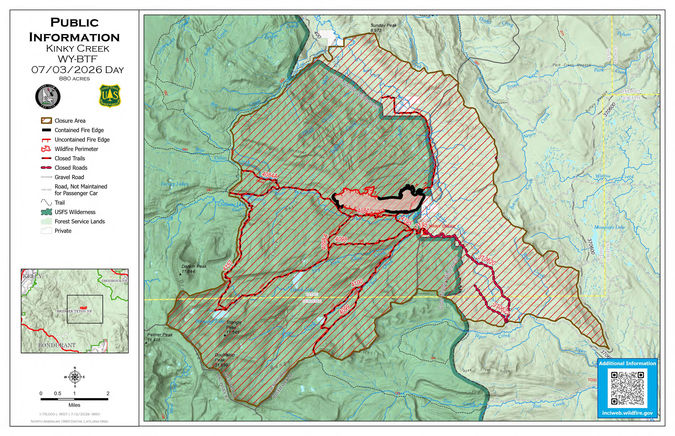
Forest trail and area closures remain in effect to protect public and firefighter safety. The public is asked to avoid Kinky Creek Road; Kinky Creek and Clear Creek trails; and the Brewster, Lunch, and Chateau Lake areas while suppression activities continue.
The Kinky Creek Fire is located west of Darwin Ranch, near Upper Gros Ventre Falls in the Gros Ventre Wilderness on the Jackson Ranger District of the Bridger-Teton National Forest.
Unless significant changes in fire activity occur, this will be the final daily update for the Kinky Creek Fire. Future information will be provided by the Bridger-Teton National Forest as needed.
|
Road work planned in July for Kemmerer wildlife overpass installation (posted 7/3/2026)
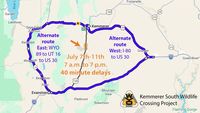
40-minute road delays July 7-11, alternate routes recommended for travelers
Wyoming Department of Transportation
Public Notice to Kemmerer area travelers:
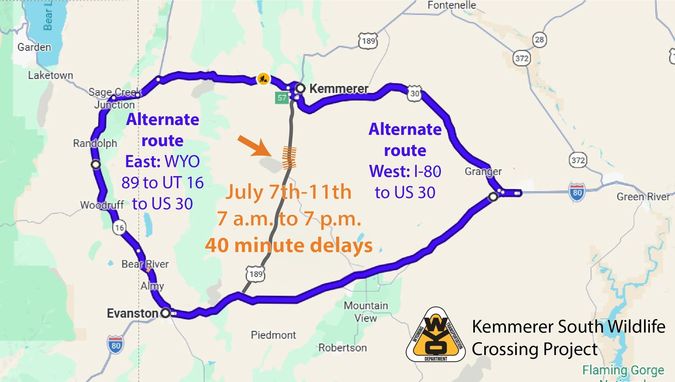
Beginning Tuesday, July 7, 2026, drivers on US 189 will see up to 40-minute delays as Wyoming Department of Transportation (WYDOT) and contract crews set sections of concrete arch for the wildlife overpass at mile marker 24.5 between Kemmerer and Evanston, Wyoming.
The work will take place from 7 a.m. to 7 p.m. for an estimated five days, July 7-11. Drivers are advised to seek alternate routes to their destinations, such as WY 89 to US 30 through the Utah border, or I-80 to US 30 via Granger.
"This can be dangerous work, with a large crane moving massive concrete sections. It’s the type of work that would be difficult to do at night safely, so for the safety of crews and the traveling public, we are doing the work during the day. Unfortunately, that means there will be times of extensive stop delay," WYDOT resident engineer Jennifer Hoffman said.
Kinky Creek Fire Update for July 3, 2026 (posted 7/3/2026)
Lightning Caused, 880 Acres, 56% Contained, SET status lifted for Darwin Ranch area
Bridger-Teton National Forest
Firefighters continue to make significant progress on the Kinky Creek Fire, increasing containment to 56% through the continued hard work and dedication of crews assigned to the incident. Suppression efforts over the past several operational periods have strengthened containment lines and secured additional portions of the fire perimeter.
Ground crews remain focused on improving and reinforcing containment features while identifying and addressing areas of residual heat near the fire's edge. Aviation resources continue to support operations as needed, assisting firefighters working in steep, rugged terrain where access remains challenging.
The incident organization has begun right-sizing to match the current needs of the fire. As containment increases and suppression objectives are achieved, excess resources are being released to support other incidents across the region. Personnel assigned to the fire have been reduced to 114.
Safety remains the highest priority. Firefighters continue to work in challenging conditions that include steep slopes, hazardous fire-weakened trees, and changing weather patterns. Through diligent risk management and adherence to safety protocols, crews continue making progress while minimizing exposure to hazards.
Weather conditions remain a factor in daily operations. Thunderstorm activity and associated outflow winds may continue to challenge firefighting efforts, requiring firefighters to remain alert to rapidly changing conditions. Fire operations will continue to monitor forecasts and adjust tactics as necessary to maintain firefighter safety and operational effectiveness.
A closure order remains in effect for portions of the fire area. The public is asked to avoid Kinky Creek Road; Kinky Creek and Clear Creek trails; and the Brewster, Lunch, and Chateau Lake areas so firefighters can work safely and efficiently.
As containment increases and fire activity decreases, local emergency managers have reduced precautionary measures for nearby residents. Teton County Emergency Management has lifted the SET status for Darwin Ranch and surrounding private lands due to the reduced threat posed by the fire. Residents and visitors are encouraged to remain aware of current conditions and continue monitoring official sources for incident information.
The Kinky Creek Fire is located west of Darwin Ranch, near Upper Gros Ventre Falls in the Gros Ventre Wilderness on the Jackson Ranger District of the Bridger-Teton National Forest. The fire is burning in heavy timber on steep, rugged terrain.
Governor seeks public comment on proposed Sage Grouse Executive Order Revisions (posted 7/3/2026)
Governor Gordon media release
Governor Mark Gordon (R-WY) is seeking public comment on proposed revisions to the Sage Grouse Executive Order. These changes stem from updates to the Governor’s Executive Order 2019-3 Greater Sage Grouse Core Area Protection.
https://drive.google.com/file/d/1MO0i6GaNWmg52tUJm5SoezpbyhLjc6Jp/view
"Wyoming has consistently advocated for a Greater sage-grouse strategy that recognizes the State’s management authority over the species utilizing the best-available science," Governor Gordon said. "Wyoming remains a leader in the sage-grouse conservation, and the State of Wyoming’s Executive Order Greater Sage-Grouse Core Area Protection has proven to be a successful strategy that has spanned three Governors in its foresight to have a state-lead conservation strategy. We appreciate the public’s input as we continue to invest in sage-grouse conservation alongside responsible development in Wyoming."
Written comments will be accepted through 5 p.m. July 30.
https://docs.google.com/forms/d/1puuShF4o6yTsheya2PxV4Y4a8LVKDtTWZuro3lLLM5s/edit?ts=6a19b3c8
|
Business
Directory
|